
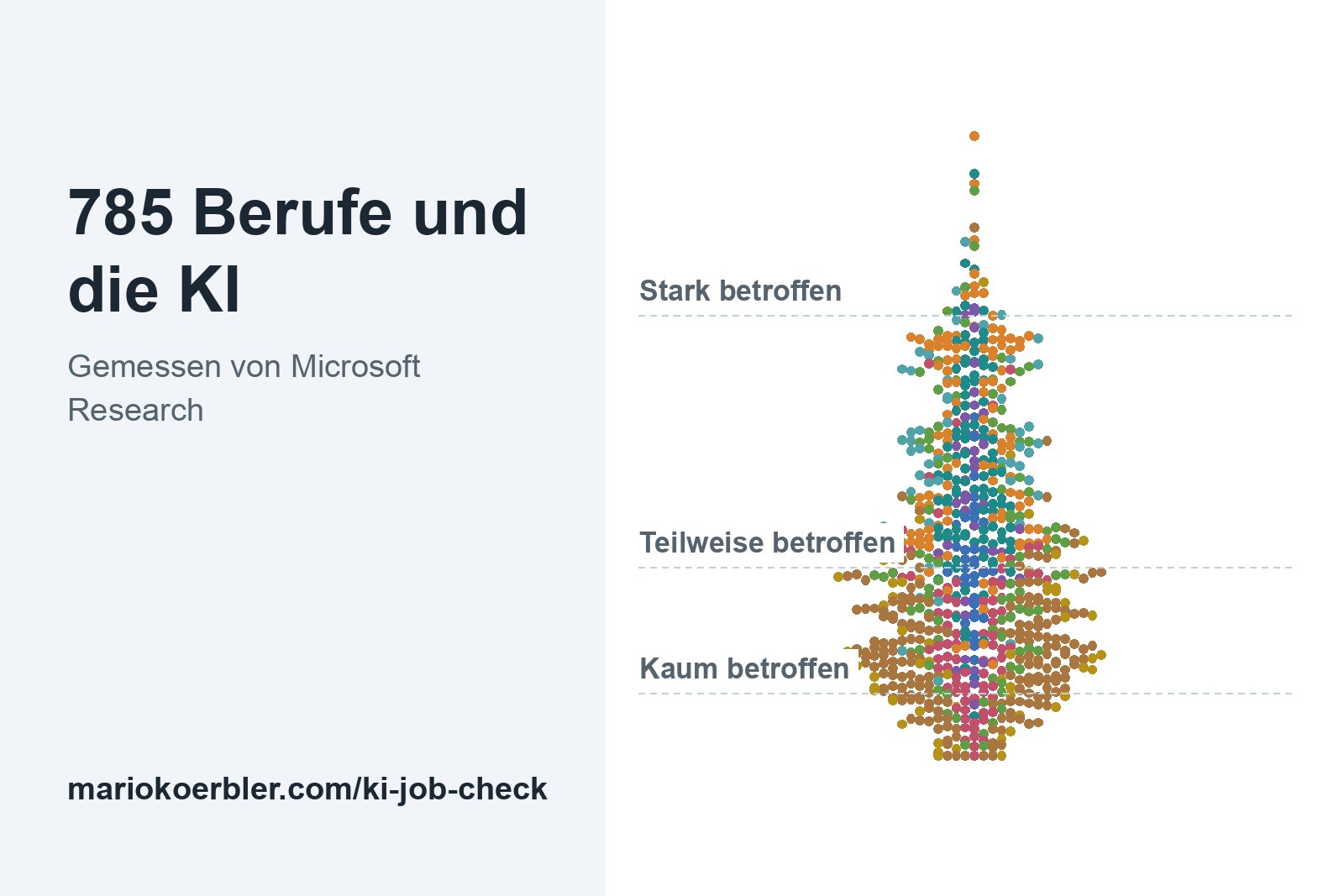
From the building site to the office: artificial intelligence changes occupations to very different degrees. Until now, hardly anyone knew where their own stood. So I turned the data into something you can use.
Where the numbers come from
Microsoft Research analysed around 200,000 anonymised conversations with an AI assistant over nine months and mapped each one to the work activities the US occupational classification records for occupations. That produces a value for 785 occupations: how much of the typical work matches what people actually use AI for today - and how successfully.
The study is published under an open licence. I took the data, translated all 785 occupation titles into German, and built a page where you can type in your own job.
What you see there
Each of the 785 occupations is a dot in a cloud. One button splits the cloud into nine occupational groups, and the pattern becomes visible at a glance: education, media and social work sit at the top, trades, construction and production at the bottom. Type in your occupation and you see your own dot, the reading, and the comparison with all the others.
What the number does not say
This is the important part, and the researchers stress it themselves: a high value does not mean an occupation disappears. Interpreters have the highest value of all - they are not going away, but their work will look different in five years. The number measures overlap, not displacement.
Two caveats belong with it: the data comes from the US and from a single AI assistant, and it captures the state of 2025. For the Austrian labour market it is an indication, not a measurement.
The graphic is here: https://www.mariokoerbler.com/en/ai-job-check