
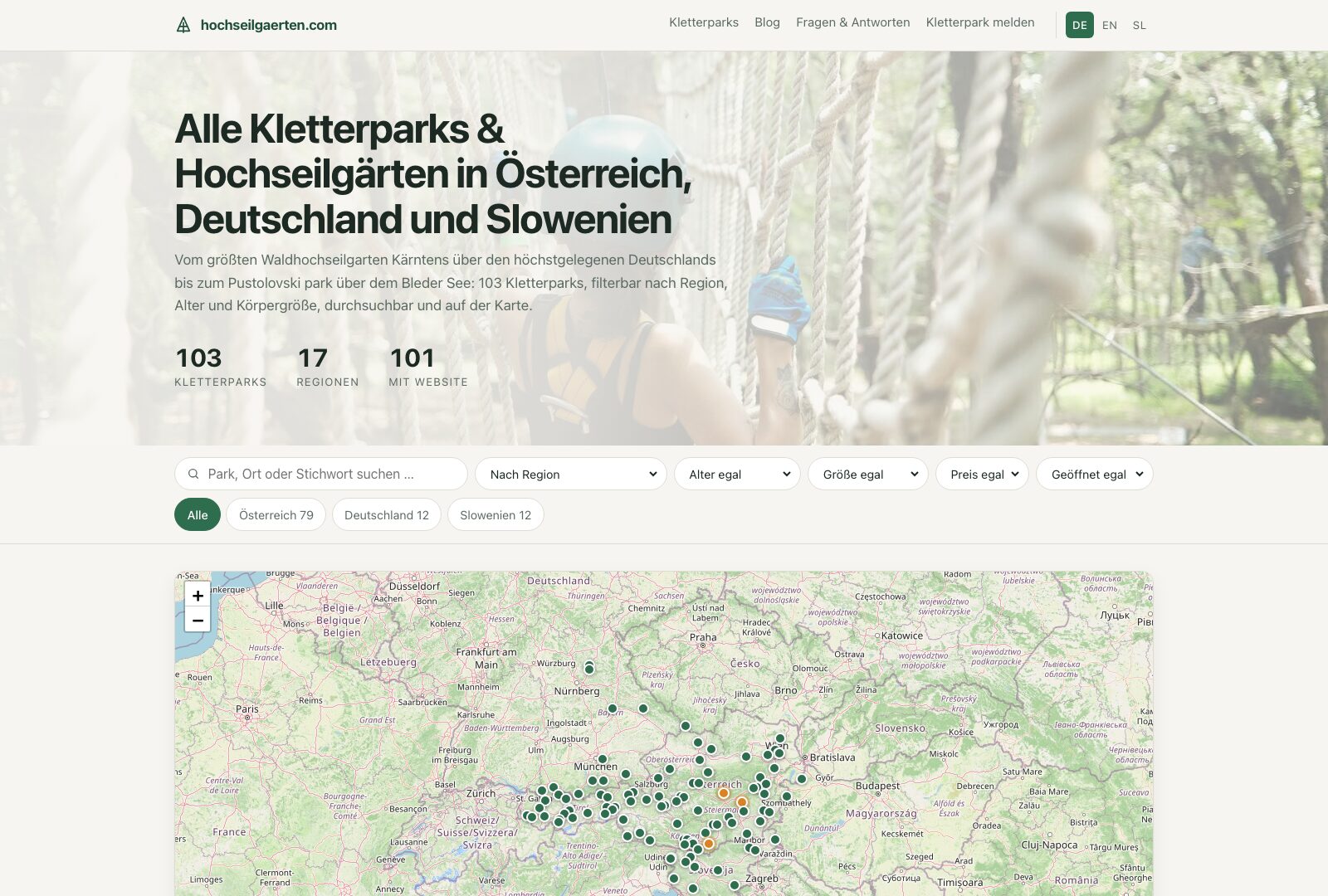
kletterparcours.at has become hochseilgaerten.com — and the portal now reaches beyond Austria 🌲
👉 https://www.hochseilgaerten.com/
The portal brings together every climbing park, high ropes course and forest rope park in Austria, Germany and Slovenia in one place: 103 facilities across 17 regions, on a map, searchable and filterable by region, country, age, height and price.
New name, new address
Since August 2026 the portal has lived at hochseilgaerten.com. The reason is simple: “Kletterparcours” is a word the industry itself barely uses. Of the 103 facilities in the directory, 22 carry “Hochseilgarten” in their name — not one carries “Kletterparcours”. People search for what is written on the sign.
There is a technical reason too: search engines tie a .at domain to Austria. The moment facilities from other countries join, that becomes a handicap. The old address permanently forwards every single page to the new one, so existing links keep working.
The first step beyond Austria: Bavaria
Bavaria is in. The locations come from the open geodata of the Bavarian Surveying Administration; everything else I looked up on the operators' own pages: prices, minimum age, minimum height, season dates — each with the date it was checked, so you can see how old a figure is.
Some of them are worth remembering: Germany's highest-lying forest ropes course at around 1,400 metres beside the top station in Oberstdorf, Bavaria's largest climbing park with 19 courses in the Allgäu, and a park near Regensburg whose courses are graded by age — four, six, thirteen and sixteen each unlock a larger share of the site.
Why I built it
Looking for a suitable climbing park usually ends with ten open tabs. Every facility has its own website, and every one states the rules differently — some by age, some by height, some not at all. If you want to know what is within reach and whether your own child is allowed up there yet, you end up searching longer than the drive takes.
That was the whole reason for this: one page where all the facilities sit side by side, with the details you actually need before a day out.
What's on it
The home page puts every location on a map. Below it sits the list, filterable by province or region, by country and by the age of your child. Each facility has its own detail page with a short description, minimum age or minimum height, the operator's website, coordinates, a directions link and a note on what is possible for children.
Three of the facilities I visited myself — the photos there are my own. There is also a small guide section: what is possible at what age, which are the country's largest climbing parks, and where the longest ziplines hang. The whole site is available in German, English and Slovenian.
All of the information comes from operator websites, tourism information and OpenStreetMap — and it changes. That's why the same note appears on every page: please check directly with the operator before you set off.
Why climbing matters so much for children
A climbing park does something a playground cannot, and a screen certainly cannot: it puts a child in front of a real, tangible task. That first step from the tree onto a swaying rope is a small moment of truth. The child is scared — and goes anyway. Or doesn't, and turns back, which is just as fine. Either way, the child decides.
There is no substitute for that experience. I have been watching it for years in Hap-Ki-Do training for children: kids don't grow through what comes easily, but through what they didn't dare to try at first. A course eight metres up in the trees delivers exactly those moments — one after another, one per element.
Then there is the physical side. Climbing asks for the whole body: balance, grip strength, coordination, stamina. It demands concentration, because you clip your own carabiner and there is nobody to ask. It teaches thinking step by step rather than in results. And it happens outdoors, in the forest, in any weather, at a height where a child looks down at the treetops for the first time instead of up at them.
Better than an hour in front of a screen
I am no cultural pessimist — I earn my living with software. But I do believe we owe our children something no device can deliver: experiences that can hurt, that you have with your body, and that you cannot restart.
A screen rewards immediately and asks for nothing. A high ropes course turns that around: first it asks — for courage, attention, effort — and then it rewards. That order is exactly how children learn that they can make something happen themselves. After four hours in the forest they are exhausted, filthy and proud. I know of no game that produces that feeling.
So this portal is not purely a data project. If it means a few more families spend a Saturday in the forest instead of on the couch, it has served its purpose.
Get involved
Facilities are certainly still missing, and some details will be out of date. The site has a form for exactly that: report a facility. Every tip from operators, parents or clubs is welcome — feel free to write to me at office@hochseilgaerten.com.