
There is a phrase everyone knows: work smarter, not harder. It hangs on posters in open-plan offices, it gets quoted at conferences, and nobody argues with it, because it sounds so obviously right.
Scott Wadsworth argues with it. Not entirely, but at the point that matters.
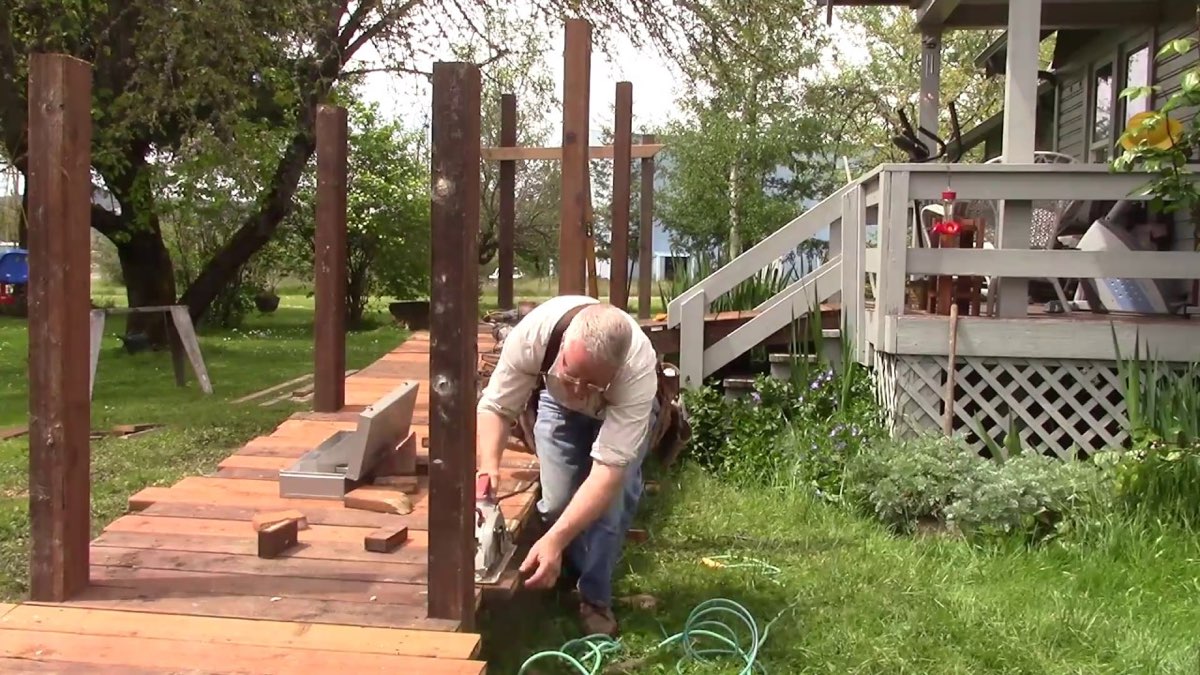
Wadsworth runs the YouTube channel Essential Craftsman. He is a builder and blacksmith from Oregon with some forty years on construction sites behind him, and he films himself working. In this video he is building a ramp for his mother — not a sophisticated carpentry project, as he puts it himself, just a deck that is inclined. Along the way he explains what, after forty years, bothers him about that phrase.
The phrase plays down one half
His objection: the axiom implies that if you are smart enough, you will not have to work so hard. It treats thinking about the method as the real proof of intelligence — and the effort as something you spare yourself by being clever.
His image for it will land with anyone who has ever sat in a project meeting: you can stand around discussing how best to do something until the job would long since have been finished, and finished well, if someone had simply put their head down and started. By then the debate about the optimal method has just about slowed enough for the first person to pick up a tool.
He is overstating it on purpose. But anyone being honest recognises the scene.
Hard work can be trained
The second idea is the one I took away from the video: Wadsworth describes physical work as an athletic event. Athleticism can be improved. Muscles respond, timing gets better, and at some point a whole new dimension appears — the question of how to work hard and enjoy it at the same time.
He describes it as a competition with himself: how much did I get done yesterday, last week, a year ago? When did I beat my own time? He admits he has shovelled gravel off a trailer simply because it felt good to shovel. Not every action has to make money.
That is the part almost entirely lost in knowledge work. We measure utilisation, but hardly anyone knows whether they are better today than they were a year ago.
What really makes the difference: the system
Then comes the sentence this article is really about. Tools, materials, working conditions — all of that is part of working smarter. But what actually separates the productive individual from everyone else is the system that individual puts in place to get the work done.
And then he gets specific. Divide the work into distinct tasks and stay on one of them as long as possible instead of jumping back and forth between related tasks. When you are moving lumber, move all the lumber. When you are cutting, make as many cuts as you can. When you are drilling, drill all the holes.
His reasoning is not efficiency mysticism, it is concrete: fewer tools are laid out at once, the workspace stays clean, and you build muscle memory by performing the same movement thirty or four hundred times. Next time your body is faster from the very first moment. You will almost always get faster at a task by repeating it — so repeat it.
That is, in a carpenter's language, precisely the argument against context switching. Every jump between two tasks has a setup cost, in your head just as much as on a building site. And it is very nearly what we are building with 1Tool: not more features, but fewer switches between tools, less searching, fewer duplicated steps.
Two of a trade never agree
The last point is the most uncomfortable. Wadsworth quotes a warning from C. S. Lewis that has stuck with him: "two of a trade never agree." People who spend their lives doing the same kind of work rarely consider the other person's method to be its equal. Because it is mine, it must be better.
His antidote is a decision you make in the morning, before you ever get to work: that everyone you meet that day knows something you could learn from them, if you want to learn it. Pay attention to how someone handles material. How they stage their work. How they lay a board in place.
After a while, he says, people start asking where you learned all that. And you never have to mention that you picked it up simply by keeping your eyes open while earning a living.
Smarter and harder
Wadsworth also quotes Robert Frost in the video, "Two Tramps in Mud Time" — a poem about a man splitting wood and enjoying it, until two strangers turn up who want the job for pay. A carpenter quoting a poet from Vermont on a job site: that alone makes the video worth watching.
His conclusion after forty years: the axiom is good as far as it goes. But anyone who really wants to get something done has to ask both questions at once. Not smarter instead of harder. Smarter and harder, until the sun goes down.