Almost every company can say in one sentence WHAT it does. Hardly any can say in one sentence WHY it does it.
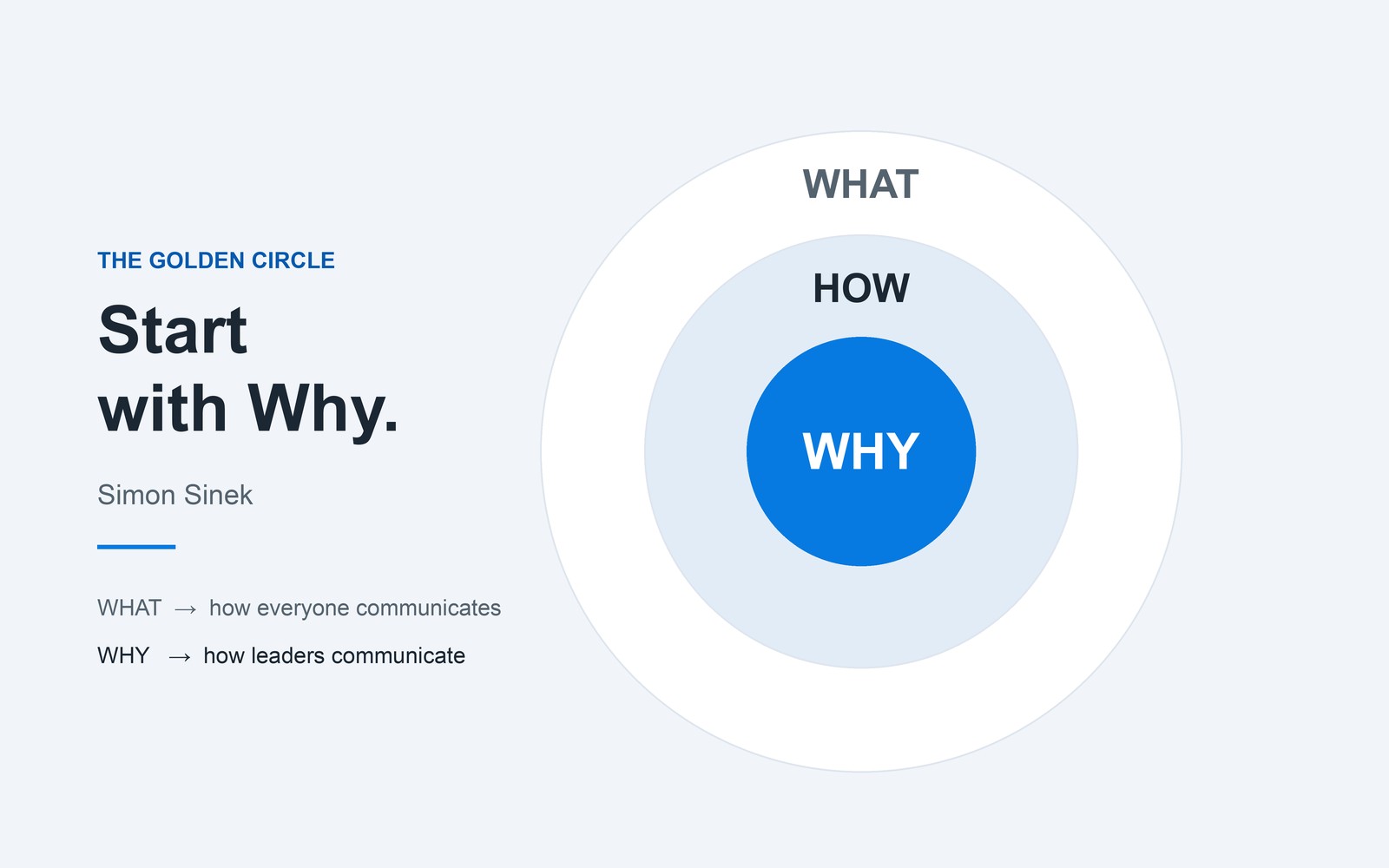
In 2009 Simon Sinek built a model for exactly that, and it has been hanging in leadership seminars ever since: the Golden Circle. Three rings, three questions. And between them lies the difference between an interchangeable supplier and one that people follow.
I have spent more than twenty years working with companies — my own, and thousands of client businesses I have digitalised. If I had to name one single reason why some of them grow while others keep struggling, it would be this question.
The Golden Circle in three sentences
The outer ring is the WHAT. Everyone can answer that: we build software. We fit windows. We do tax advice.
The middle ring is the HOW. Noticeably fewer can answer that one: their way of working, the promise, the thing that sets them apart.
The inner ring is the WHY. Not "making money" — that's a result, not a purpose. The WHY is the conviction behind it all. The reason your company exists at all.
Sinek's central observation: most people communicate from the outside in — from the WHAT to the WHY. Those who inspire do it the other way round.
Why this isn't a marketing trick
Sinek argues from the structure of the brain: the neocortex processes language, numbers and facts — the WHAT. The deeper areas, the ones associated with feeling, trust and decision-making, have no language. That is where the decision is made, and only afterwards do we go looking for the arguments.
Whether that mapping is neurologically that clean is debatable. As a model for why people rarely decide purely rationally and still justify their decisions rationally afterwards, it works remarkably well.
Everybody knows the sentence "it just felt right". That's not an argument. But it is the reason the purchase happened.
Why SMEs benefit from this more than corporations
The Golden Circle is usually explained using Apple. That's unfortunate, because it creates the wrong impression: that you need a billion-euro budget to communicate this way.
The opposite is true.
A corporation can buy attention. When a global player has nothing to say, it simply books more advertising. A business with twelve employees can't. For small and medium-sized companies, conviction isn't one communication style among many — it is the only currency they have in abundance, and the only one no competitor can copy.
There's a very practical effect on top of that. Communicate only the WHAT and you make yourself comparable. And anything comparable gets decided on price. Three quotes, identical scope, cheapest one wins. Communicate your WHY and you leave that comparison behind.
I see it every day with trades businesses, agencies, law firms and software companies. Two companies, same service, same region. One writes "We fit windows across the country." The other writes "We believe a house is only finished once nobody ever has to think about it again." The second one doesn't just get different customers — it gets different employees.
The point where it really hurts for SMEs: people
For most businesses, finding skilled people has long been a bigger problem than finding orders.
And this is exactly where the WHAT fails most spectacularly. "We are looking for an electrician, 38.5 hours, driving licence required." That's a description, not a reason.
A corporation beats you on salary. On the WHY, you win. People — and young people in particular — choose workplaces whose purpose they understand. Tell your team only WHAT to do and you get tasks completed. Explain WHY, and you get people thinking along with you.
That difference costs nothing and decides whether your best employee is still there in five years.
Why I take this seriously
My own WHY has become clearer over the years, not more complicated: I want people in companies to have an overview again.
Not "sell CRM". Not "build modules". But bring order into a chaos that most businesses have long accepted as normal — scattered data, duplicated work, gut feeling instead of numbers.
And because that is my WHY, it doesn't only apply to software. It's the same thought I write about in my book on parenting, and the same one I see in Hap-Ki-Do training with kids: clarity isn't a talent, it's a discipline.
If your WHY is real, it doesn't stop at the office door.
Why the Golden Circle works in private life too
Sinek is describing leadership — but the model isn't limited to companies.
Job applications: a CV is a pure WHAT list. Positions, titles, years. Which is precisely why five people with comparable lists end up in the same interview process. The one who can say why they chose this profession, and what still won't let go of them about it, is the one people remember.
Parenting: "because I said so" is WHAT. Children follow a WHY they have understood far more reliably than an instruction — not immediately, but lastingly. And unlike an instruction, it still works when nobody is watching.
The things we keep abandoning: sport, diet, learning a language. A WHAT is "run three times a week". That lasts until the first rainy day. Anyone who knows their WHY has an argument on bad days.
Saying no: perhaps the most underrated effect of all. Once you know your WHY, most requests no longer require any thought. Clarity about purpose is the best filter there is — professionally and privately.
The test that hurts
Three questions I put to every entrepreneur who tells me their WHY is clear:
First: can your employees state your WHY in one sentence — without thinking about it, and without every one of them saying something different?
Second: does your homepage open with a WHY or with a list of services? Right at the top, in the first two lines.
Third: if you sold your product tomorrow and offered something completely different — what part of your company would still stand?
If the third question is hard, that isn't a bad sign. It just means the WHAT has been holding the company together so far. That works — until the market turns.
Why this matters more in the age of AI than ever before
And now for the part that occupies me most as an entrepreneur right now.
I work with AI agents every day. I see how fast products come into existence today that used to take us months. And there's a consequence most people haven't thought through yet: the WHAT is becoming arbitrary.
Every feature is copyable. Every text is generated in seconds. Every website, every offer, every product description. What is a head start today is a standard feature everyone has twelve months from now.
But if the WHAT becomes arbitrary and the HOW becomes automatable, then exactly one ring is left that cannot be copied.
The WHY is the one thing an AI cannot invent for you. It can phrase it, translate it, scale it and push it into a thousand channels. But it cannot decide what you stand for.
My conviction: over the next few years customers will stop choosing by feature lists — they're all the same length anyway. They will choose by trust. And trust is nothing other than a WHY that somebody has stuck with long enough.
Anyone who only has a WHAT today will be a price comparison in five years.
The TED talk
If you have half an hour: this is the 2009 talk that started it all. One of the most-watched TED talks ever — and more relevant today than it was back then.
More on Simon Sinek, and why he is one of the people who shaped my thinking, is collected here: https://www.mariokoerbler.com/en/inspiration/simon-sinek.html
What I would leave you with
Don't start by rewriting your website.
Start with a question you answer honestly: why did you begin back then? Not the version for the sales pitch — the real one.
That answer is rarely elegant and almost never marketing-ready. But it is the only part of your company nobody can rebuild.
The rest is translation work.