
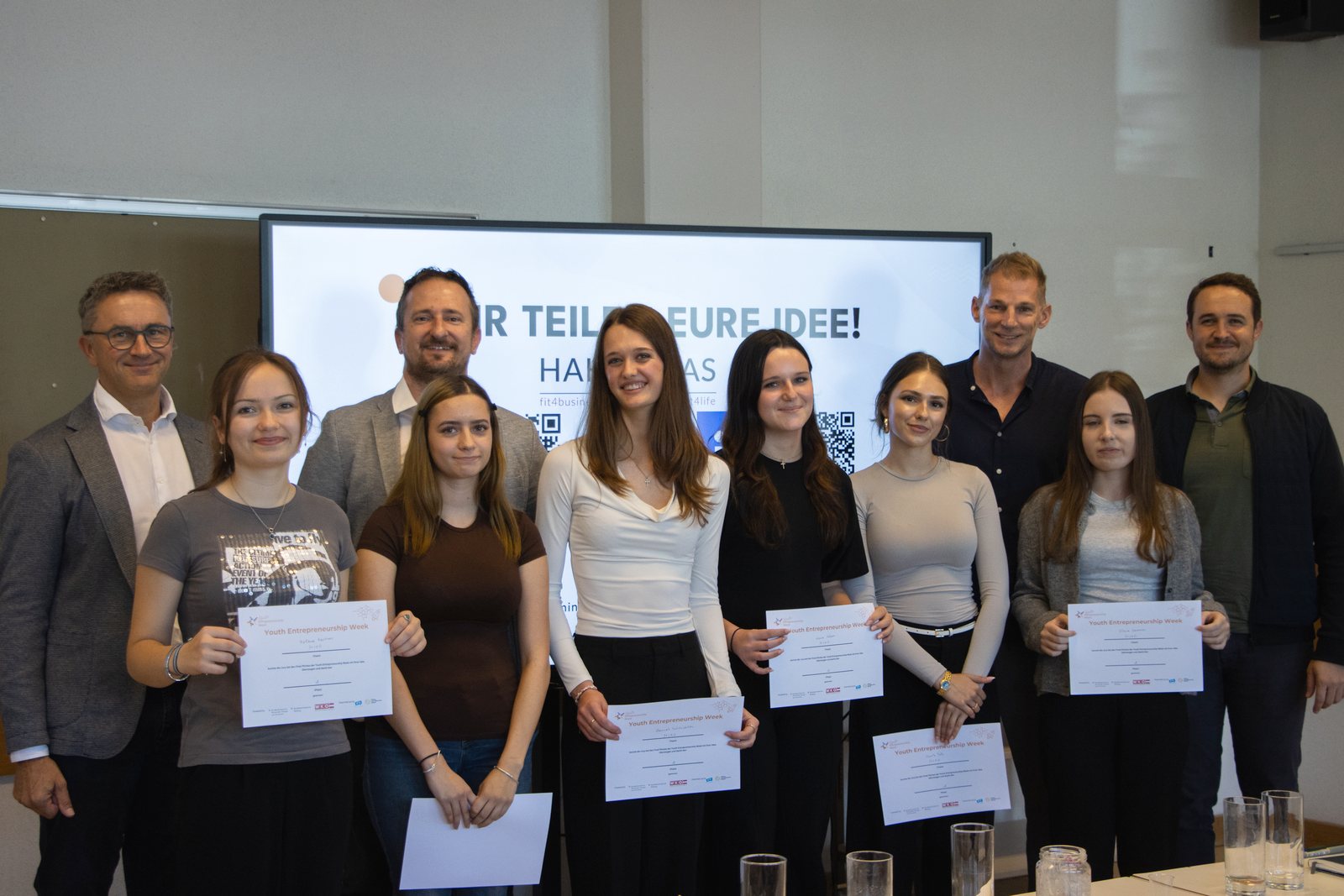
On Monday the teams had a rough direction. By Thursday they stood in front of the jury with a prototype, a website and numbers.
In between were four days of the Youth Entrepreneurship Week at BHAK BHAS Leibnitz, and I had the privilege of taking part together with Manuel Kleinböck as a mentor and as a member of the jury. Here I write down what happened that week, which ideas made it onto the stage and what I take away from it as an entrepreneur.
What the Youth Entrepreneurship Week is
The Youth Entrepreneurship Week (YEW for short) brings entrepreneurship straight into the classroom. Within just a few days, students work in teams to develop their own business idea, get feedback from mentors with real-world experience along the way, and at the end present their result in a pitch to a jury.
In Leibnitz the week was led by Michael Yang and Marlene from human-intelligence.studio. The school's teachers handled the organisation behind the scenes and accompanied their classes throughout the week. We mentors had a double role: asking questions during the week, judging on Thursday.
Monday: ideas that are still vague
Every good idea starts out blurry. On Monday a lot of it still sounded like “something to do with health” or “something for gamers”. That is not a mistake, it is the normal starting point. What is exciting is how quickly a feeling like that turns into a concrete offer when you ask the right questions.
Mentoring: the right questions instead of ready-made answers
Mentoring is not about handing the young people a solution. The questions I ask in these conversations are almost always the same, and they are the same ones I ask myself at the start of every new project in my own companies:
Who exactly buys this, and in what situation? Which problem is so annoying that someone will pay money to solve it? What does it cost to make, and what can it cost? And: what can you actually show by Thursday?
The last question is the most important one. A pitch does not convince through big words, but through something you can touch, try out or click on.
Thursday: three ideas that stuck
On Thursday it was time to pitch. I would like to show three teams here as examples, because they illustrate how different the approaches were.
Mixo To Go: breakfast in a jar for people on the go
Mixo To Go is breakfast in a jar: oats, fruit and nuts, ready-mixed. You pour in milk, put the jar in the microwave for two minutes and have a warm, filling breakfast, whether at the office, at school or at university.
The team did not just have a presentation, but a finished website as a prototype, with flavours, how it works and a clear value proposition. On the jury table there were samples in jars. It is hard to put “show it, don’t explain it” into practice any better than that.
4Rage: a gaming drink with a clear target group
4Rage is the concept for a gaming drink in three flavours: cherry, citrus and mango. The claim on the website: “Dein Game. Dein Fokus.” (Your game. Your focus.)
What I liked: the target group is unambiguous, the can design speaks to exactly that target group, and here too the team’s own website with product pages, FAQ and a shop section was already running in the browser.
unplugged: using the phone so that you put it down
Perhaps the boldest idea came from the unplugged team. Their line on the slide: “We use the phone to get people to put it down.”
The app sets missions that you complete outdoors, rewards streaks and lets friends cheer each other on. Slogan: “Handy weg. Crew raus.” (Phone away. Crew out.) The fact that it is young people of all people who design an app against too much screen time shows how closely they observe their own surroundings.
What I take away from this week as an entrepreneur
First: nobody waited until everything was perfect. The teams built, showed, gathered feedback and sharpened their ideas. That is exactly how entrepreneurship works, and it is exactly what many adults unlearn when they carry an idea around in their heads for years.
Second: today the tools are there for everyone. A working website as a prototype used to be a job for an agency. This week, student teams built one themselves within a few days, partly with AI tools. The gap between an idea and the first visible result has never been this small.
Third: courage can be trained. Standing in front of a jury and defending your own idea is a real hurdle for young people. Every group cleared it. Whether they won or not, that experience stays with them.
Why entrepreneurship belongs in school
Entrepreneurial thinking does not mean that everyone has to start a company. It means recognising problems, trying out solutions and taking responsibility for a result. Businesses need that from their employees just as much as founders need it from themselves.
Formats like the Youth Entrepreneurship Week make this tangible in just a few days. I would happily take part in something like this again.
Thank you
Thank you to Michael and Marlene from human-intelligence.studio for the format and the invitation, to the teaching team at BHAK BHAS Leibnitz for the organisation, to Manuel Kleinböck, with whom I tackled this week side by side, and to all my fellow mentors and jury members. But above all, thank you to all the students for your courage. Keep at it!
human-intelligence.studio: https://human-intelligence.studio
BHAK BHAS Leibnitz: https://www.hak-leibnitz.at
The photos from the week are also available as a post on Instagram: https://www.instagram.com/p/DeH9xRRkdGe/